 Beauty influencer @MissDarcei shows TirTir cushion foundations that now suit her skintone/ Courtesy of @MissDarcei
 SEOUL, November 04 (AJP) - “You guys have no idea how happy I am right now — it’s literally perfect. I can finally use their cushion foundation,” said @MissDarcei, a beauty influencer with more than 800,000 YouTube followers. Her excitement reflects a growing wave of international consumers who say Korean cushion foundations now work just as well on darker skin tones as they do on lighter ones. The secret behind the viral rise of K-beauty lies in its fast-expanding shade ranges, with some brands now offering up to 40 different tones designed to match a global, multiracial consumer base.
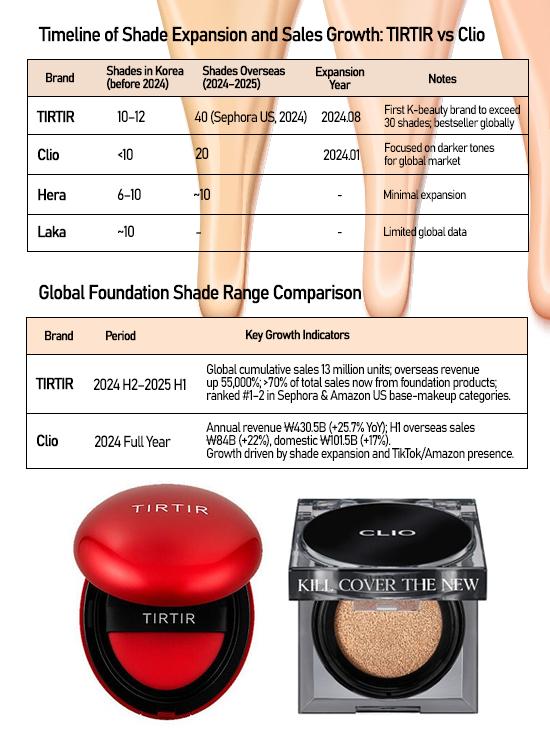
TIRTIR and Clio may not be the best-known legacy beauty houses in Korea, but they have emerged as major forces on social media by redefining what a Korean base shade can be. TIRTIR became the first Korean brand to surpass 30 shades in a single line when it released 40 foundation tones in August 2024. The move targeted deeper and darker skin tones across the United States, Europe, and Latin America. Since launch, global cumulative sales have topped 13 million units, and more than 70 percent of the company’s total revenue now comes from foundation. Its Mask Fit Cushion has repeatedly dominated Sephora U.S. and Amazon’s base-makeup rankings, achieving a surge of more than 55,000 percent in overseas sales within months. A company comment will be added.
Clio followed in January 2024 by expanding its Kill Cover foundation range to 20 shades, introducing newly developed darker tones to appeal to a broader spectrum of global consumers. The company strengthened its presence on TikTok and Amazon while accelerating entry into U.S. and U.K. retail channels. Clio recorded 430.5 billion won in revenue in 2024, up 25.7 percent from the previous year. Overseas sales rose 22 percent in the first half to 84 billion won, while domestic revenue increased 17 percent to 101.5 billion won.
 Graphics by AJP Song Ji-yoon
 The momentum from these shade expansions has also reshaped Korea’s manufacturing base. Major OEM and ODM producers including Cosmax and Kolmar Korea have intensified pigment-development research to meet demand for darker shades and customized tones, reflecting global trends in multi-ethnic cosmetic science. “Korean cushion foundations are known for their outstanding quality. When I visited Korea in 2019, I planned on buying one but was disappointed because the shades were far too pale for my skin,” said Jenny Kim, a 30-year-old from Utah. “Now that the brands have expanded their shade range, I can finally use them.”
 Clio’s “Kill Cover Founwear Cushion The Original,” launched on Amazon US/ Courtesy of Clio
 Influencers such as Miss Darcei and Suellen Gomes, prominent among Black and Latinx audiences, have praised Korean brands for finally offering tones that match their skin. Hashtags including #TIRTIR and #Kbeautydiversity have gone viral across TikTok and YouTube as deeper-shade users share surprised reactions and before-and-after videos.
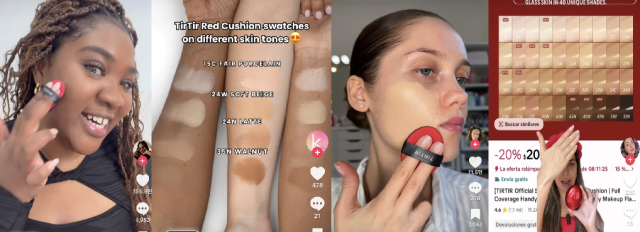 TIRTIR's cushion goes viral among beauty influencers on TikTok/ TikTok
 The rise of inclusive Korean foundations did not happen overnight. K-beauty’s double-digit market share in the United States and Europe reflects years of experimentation, reformulation, and persistence by Korean brands determined to meet the expectations of global consumers. “The widening shade spectrum of Korean beauty brands appears to be having a significant impact on exports,” said an official at the Korea Trade-Investment Promotion Agency.
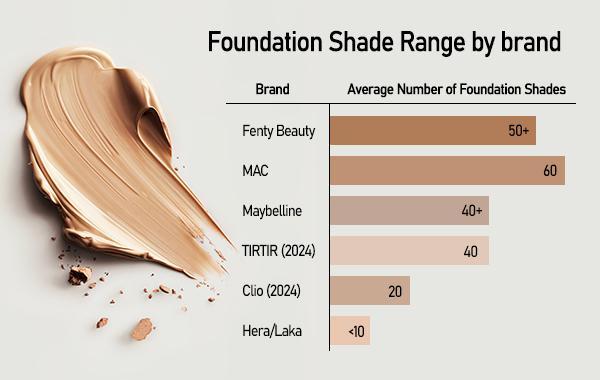
While Western giants such as Fenty Beauty and MAC still lead with 50 to 60 shades respectively, Korean brands are narrowing the gap with surprising speed. TIRTIR now offers 40 shades globally, followed by Clio’s 20, while brands such as Hera and Laka provide fewer than ten. The shift marks a major philosophical transition in K-beauty: a move away from exporting a single, bright-skin ideal toward embracing a more universal, consumer-driven approach that recognizes skin tone diversity as a core part of global beauty culture.
 Graphics by AJP Song Ji-yoon
 Candice Kim 수습기자 candicekim1121@ajupress.com

![[포토] 예지원, 전통과 현대가 공존한 화보 공개](https://image.ajunews.com/content/image/2025/10/09/20251009182431778689.jpg)
![블랙핑크 제니, 최강매력! [포토]](https://file.sportsseoul.com/news/cms/2025/09/05/news-p.v1.20250905.ed1b2684d2d64e359332640e38dac841_P1.jpg)
![[포토] 발표하는 김정수 삼양식품 부회장](https://image.ajunews.com/content/image/2025/11/03/20251103114206916880.jpg)
![[포토]두산 안재석, 관중석 들썩이게 한 끝내기 2루타](https://file.sportsseoul.com/news/cms/2025/08/28/news-p.v1.20250828.1a1c4d0be7434f6b80434dced03368c0_P1.jpg)
![블랙핑크 제니, 매력이 넘쳐! [포토]](https://file.sportsseoul.com/news/cms/2025/09/05/news-p.v1.20250905.c5a971a36b494f9fb24aea8cccf6816f_P1.jpg)
![[포토] '삼양1963 런칭 쇼케이스'](https://image.ajunews.com/content/image/2025/11/03/20251103114008977281.jpg)
![[포토] 박지현 '순백의 여신'](http://www.segye.com/content/image/2025/09/05/20250905507414.jpg)
![[포토] 키스오브라이프 하늘 '완벽한 미모'](http://www.segye.com/content/image/2025/09/05/20250905504457.jpg)
![[포토] 아이들 소연 '매력적인 눈빛'](http://www.segye.com/content/image/2025/09/12/20250912508492.jpg)

![[포토] 국회 예결위 참석하는 김민석 총리](https://cphoto.asiae.co.kr/listimg_link.php?idx=2&no=2025110710410898931_1762479667.jpg)
![[포토] 박지현 '아름다운 미모'](http://www.segye.com/content/image/2025/11/19/20251119519369.jpg)
![[포토] 김고은 '단발 여신'](http://www.segye.com/content/image/2025/09/05/20250905507236.jpg)
![[작아진 호랑이③] 9위 추락 시 KBO 최초…승리의 여신 떠난 자리, KIA를 덮친 '우승 징크스'](http://www.sportsworldi.com/content/image/2025/09/04/20250904518238.jpg)
![[포토]첫 타석부터 안타 치는 LG 문성주](https://file.sportsseoul.com/news/cms/2025/09/02/news-p.v1.20250902.8962276ed11c468c90062ee85072fa38_P1.jpg)
![[포토] 알리익스프레스, 광군제 앞두고 팝업스토어 오픈](https://cphoto.asiae.co.kr/listimg_link.php?idx=2&no=2025110714160199219_1762492560.jpg)

![[포토] 키스오브라이프 쥴리 '단발 여신'](http://www.segye.com/content/image/2025/09/05/20250905504358.jpg)
![[포토]끝내기 안타의 기쁨을 만끽하는 두산 안재석](https://file.sportsseoul.com/news/cms/2025/08/28/news-p.v1.20250828.0df70b9fa54d4610990f1b34c08c6a63_P1.jpg)
![[포토] 한샘, '플래그십 부산센텀' 리뉴얼 오픈](https://image.ajunews.com/content/image/2025/10/31/20251031142544910604.jpg)
![[포토] 언론 현업단체, "시민피해구제 확대 찬성, 권력감시 약화 반대"](https://image.ajunews.com/content/image/2025/09/05/20250905123135571578.jpg)
![[포토] 김고은 '상연 생각에 눈물이 흘러'](http://www.segye.com/content/image/2025/09/05/20250905507613.jpg)
![[포토]두산 안재석, 연장 승부를 끝내는 2루타](https://file.sportsseoul.com/news/cms/2025/08/28/news-p.v1.20250828.b12bc405ed464d9db2c3d324c2491a1d_P1.jpg)
![[포토] 아홉 '신나는 컴백 무대'](http://www.segye.com/content/image/2025/11/04/20251104514134.jpg)

![[포토] TXT 범규 '반가운 손인사'](http://www.segye.com/content/image/2025/11/05/20251105518398.jpg)