 Graphics by AJP Song Ji-yoon
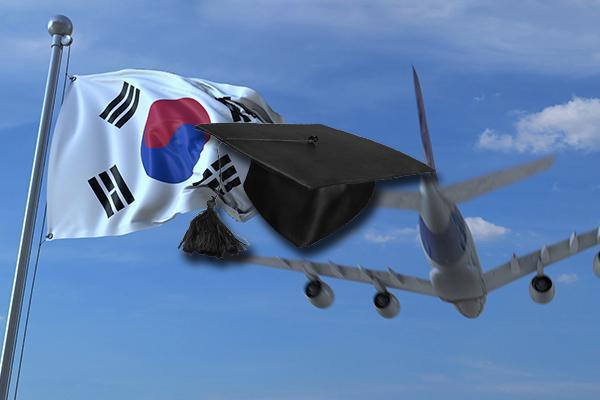
 SEOUL, November 04 (AJP) - Four out of ten South Koreans employed in science and engineering say they want to work abroad in pursuit of higher compensation and better social recognition, underscoring the talent pressures Korean companies face as global competition intensifies in AI and IT.
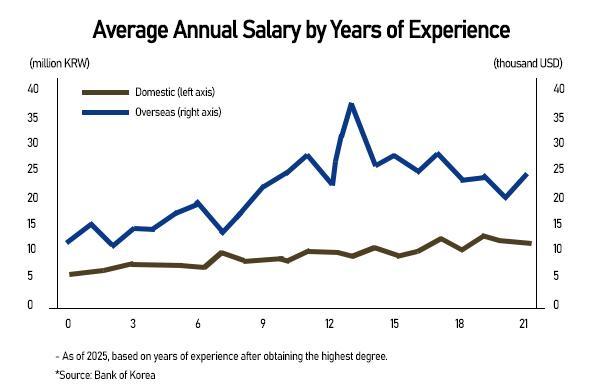
A recent Bank of Korea study found that 42.9 percent of salaried STEM-degree holders are considering relocating overseas within the next three years, and the share rises to about 70 percent among those in their 20s and 30s. Financial factors were the most frequently cited motivation, with 66.7 percent pointing to higher pay abroad.
Yoon Yong-june, head of the macroeconomic studies team at the Bank of Korea's Research Department, noted that STEM professionals in countries such as the United States enjoy strong respect, high compensation, and greater career mobility.
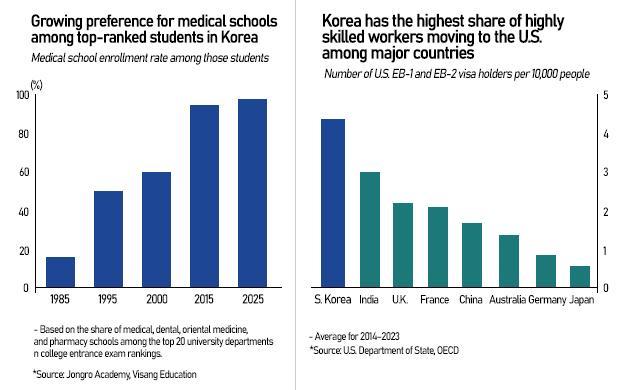
"Talented students often enter institutions like Stanford or MIT and then build careers in AI and IT in Silicon Valley, frequently becoming key innovators or founders," he said. "In Korea, by contrast, elite students in the post-IMF era increasingly opted for medical schools from the early 2000s onward, reflecting a preference for job security over engineering paths."
 Graphics by AJP Song Ji-yoon
 Dissatisfaction was highest among workers in biotechnology, pharmaceuticals, and medical devices, followed by electronics and semiconductors, and IT and communications.
Even in high-paying fields such as semiconductors and mobility, many master's and Ph.D.-level researchers said their compensation did not align with the performance of their companies.
Korean firms in IT, software, and biotech maintained similar ratios of labor costs to sales, while the ratios in core manufacturing industries such as semiconductors, electronics, and automobiles were lower.
In contrast, U.S. tech giants such as Apple and Tesla have achieved high profitability by outsourcing production and focusing on design, software, and platforms, enabling them to reinvest more aggressively in R&D and employee rewards.
The report also pointed to structural drawbacks in Korea's R&D career path, where researchers are evaluated on short-term performance, hindering breakthrough research.
It emphasized that incentives must be tied to long-horizon achievements. Korea's lack of a Nobel laureate in the sciences can explain the structural constraint.
 Graphics by AJP Song Ji-yoon
 Recent shifts in the labor market, however, suggest engineering roles are regaining appeal. With the rise of chip supremacy and escalating compensation packages, applicants for semiconductor-related university programs outnumbered those for medical schools in this year's early admissions cycle, according to Jongro Academy in Seoul.
Corporations are also moving aggressively to retain talent. Samsung Electronics announced a new Performance Stock Unit program that ties employee rewards directly to the company's share price.
Under the plan, employees will receive Samsung stock based on share-price growth over the next three years, with 200 shares granted to entry- and junior-level workers and 300 shares to mid-level managers, vesting gradually from 2028.
SK hynix, meanwhile, revised its annual bonus structure through a labor–management agreement reached in September. The company will allocate 10 percent of its annual operating profit to employee bonuses, a level that, given its workforce of around 33,600, amounts to more than 100 million won—about 70,000 dollars—per employee on average.
Kim Hee-su Reporter khs@ajupress.com

![[포토] 예지원, 전통과 현대가 공존한 화보 공개](https://image.ajunews.com/content/image/2025/10/09/20251009182431778689.jpg)
![블랙핑크 제니, 최강매력! [포토]](https://file.sportsseoul.com/news/cms/2025/09/05/news-p.v1.20250905.ed1b2684d2d64e359332640e38dac841_P1.jpg)
![[포토] 발표하는 김정수 삼양식품 부회장](https://image.ajunews.com/content/image/2025/11/03/20251103114206916880.jpg)
![[포토]두산 안재석, 관중석 들썩이게 한 끝내기 2루타](https://file.sportsseoul.com/news/cms/2025/08/28/news-p.v1.20250828.1a1c4d0be7434f6b80434dced03368c0_P1.jpg)
![블랙핑크 제니, 매력이 넘쳐! [포토]](https://file.sportsseoul.com/news/cms/2025/09/05/news-p.v1.20250905.c5a971a36b494f9fb24aea8cccf6816f_P1.jpg)
![[포토] '삼양1963 런칭 쇼케이스'](https://image.ajunews.com/content/image/2025/11/03/20251103114008977281.jpg)
![[포토] 박지현 '순백의 여신'](http://www.segye.com/content/image/2025/09/05/20250905507414.jpg)
![[포토] 키스오브라이프 하늘 '완벽한 미모'](http://www.segye.com/content/image/2025/09/05/20250905504457.jpg)
![[포토] 아이들 소연 '매력적인 눈빛'](http://www.segye.com/content/image/2025/09/12/20250912508492.jpg)

![[포토] 국회 예결위 참석하는 김민석 총리](https://cphoto.asiae.co.kr/listimg_link.php?idx=2&no=2025110710410898931_1762479667.jpg)
![[포토] 박지현 '아름다운 미모'](http://www.segye.com/content/image/2025/11/19/20251119519369.jpg)
![[포토] 김고은 '단발 여신'](http://www.segye.com/content/image/2025/09/05/20250905507236.jpg)
![[작아진 호랑이③] 9위 추락 시 KBO 최초…승리의 여신 떠난 자리, KIA를 덮친 '우승 징크스'](http://www.sportsworldi.com/content/image/2025/09/04/20250904518238.jpg)
![[포토]첫 타석부터 안타 치는 LG 문성주](https://file.sportsseoul.com/news/cms/2025/09/02/news-p.v1.20250902.8962276ed11c468c90062ee85072fa38_P1.jpg)
![[포토] 알리익스프레스, 광군제 앞두고 팝업스토어 오픈](https://cphoto.asiae.co.kr/listimg_link.php?idx=2&no=2025110714160199219_1762492560.jpg)

![[포토] 키스오브라이프 쥴리 '단발 여신'](http://www.segye.com/content/image/2025/09/05/20250905504358.jpg)
![[포토]끝내기 안타의 기쁨을 만끽하는 두산 안재석](https://file.sportsseoul.com/news/cms/2025/08/28/news-p.v1.20250828.0df70b9fa54d4610990f1b34c08c6a63_P1.jpg)

![[포토] 한샘, '플래그십 부산센텀' 리뉴얼 오픈](https://image.ajunews.com/content/image/2025/10/31/20251031142544910604.jpg)
![[포토] 언론 현업단체, "시민피해구제 확대 찬성, 권력감시 약화 반대"](https://image.ajunews.com/content/image/2025/09/05/20250905123135571578.jpg)
![[포토] 김고은 '상연 생각에 눈물이 흘러'](http://www.segye.com/content/image/2025/09/05/20250905507613.jpg)
![[포토]두산 안재석, 연장 승부를 끝내는 2루타](https://file.sportsseoul.com/news/cms/2025/08/28/news-p.v1.20250828.b12bc405ed464d9db2c3d324c2491a1d_P1.jpg)
![[포토] 아홉 '신나는 컴백 무대'](http://www.segye.com/content/image/2025/11/04/20251104514134.jpg)

![[포토] TXT 범규 '반가운 손인사'](http://www.segye.com/content/image/2025/11/05/20251105518398.jpg)