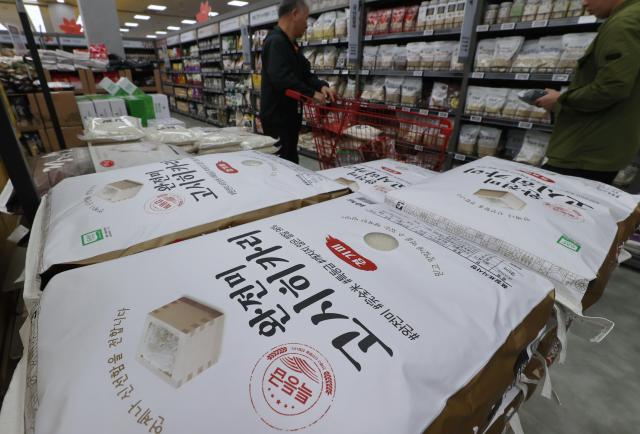
 Bags of rice displayed at a large supermarket in Seoul / Yonhap
 SEOUL, November 04 (AJP) - South Korea’s consumer inflation accelerated at the fastest pace in 15 months in October, reinforcing market expectations for another rate freeze this month as authorities attributed much of the pickup to increased spending during the extended Chuseok holiday, government data showed Tuesday.
According to the October consumer price index (CPI) released by the Ministry of Data and Statistics, headline inflation rose 2.4 percent from a year earlier, the quickest pace since the 2.6 percent gain logged in July last year.
Personal service charges — a category covering overseas travel and hospitality — climbed 3.6 percent, adding 0.7 percentage point to the overall price increase.
Prices of agricultural, livestock and fishery products rose 3.1 percent, the second-largest contributor, largely reflecting Chuseok demand as families prepared traditional holiday meals.
Ingredients for typical holiday offerings posted some of the sharpest increases: rice up 21.3 percent, apples up 21.6 percent, pork up 6.9 percent, mackerel up 11 percent, and eggs up 6.9 percent.
Dining-out prices remained firm, rising 3.0 percent, though overall fresh food prices fell 0.8 percent.
Housing costs continued to edge up on persistent market instability, with monthly rents rising 1.1 percent and long-term rental deposits (jeonse) up 0.5 percent.
Fuel prices jumped 4.8 percent, the biggest rise in eight months, due to a weaker won and a base effect from last October’s 10.9-percent plunge. Diesel rose 8.2 percent, while gasoline prices increased 4.5 percent, reflecting the combined impact of U.S. sanctions on Russian oil companies and OPEC+’s production halt.
Core inflation — excluding volatile food and energy — also strengthened, rising 2.5 percent on year.
Whether the firmer inflation will sway the Bank of Korea’s final rate-setting meeting of the year on Nov. 27 remains unclear, as policymakers view the latest uptick as largely temporary. The bond market, meanwhile, continues to discount the likelihood of a rate cut this year.
As of Monday, benchmark government bond yields stood at 2.741 percent for 3-year notes, 2.883 percent for 5-year notes, and 3.086 percent for 10-year notes, up 2.5 to 2.8 basis points.
The Bank of Korea kept its policy rate at 2.50 percent for a third straight meeting last month, with Governor Rhee Chang-yong signaling that the current easing cycle may be nearing its end.
Kim Yeon-jae Reporter duswogmlwo77@ajupress.com

![[포토] 예지원, 전통과 현대가 공존한 화보 공개](https://image.ajunews.com/content/image/2025/10/09/20251009182431778689.jpg)
![블랙핑크 제니, 최강매력! [포토]](https://file.sportsseoul.com/news/cms/2025/09/05/news-p.v1.20250905.ed1b2684d2d64e359332640e38dac841_P1.jpg)
![[포토] 발표하는 김정수 삼양식품 부회장](https://image.ajunews.com/content/image/2025/11/03/20251103114206916880.jpg)
![[포토]두산 안재석, 관중석 들썩이게 한 끝내기 2루타](https://file.sportsseoul.com/news/cms/2025/08/28/news-p.v1.20250828.1a1c4d0be7434f6b80434dced03368c0_P1.jpg)
![블랙핑크 제니, 매력이 넘쳐! [포토]](https://file.sportsseoul.com/news/cms/2025/09/05/news-p.v1.20250905.c5a971a36b494f9fb24aea8cccf6816f_P1.jpg)
![[포토] '삼양1963 런칭 쇼케이스'](https://image.ajunews.com/content/image/2025/11/03/20251103114008977281.jpg)
![[포토] 박지현 '순백의 여신'](http://www.segye.com/content/image/2025/09/05/20250905507414.jpg)
![[포토] 키스오브라이프 하늘 '완벽한 미모'](http://www.segye.com/content/image/2025/09/05/20250905504457.jpg)
![[포토] 아이들 소연 '매력적인 눈빛'](http://www.segye.com/content/image/2025/09/12/20250912508492.jpg)
![[포토] 국회 예결위 참석하는 김민석 총리](https://cphoto.asiae.co.kr/listimg_link.php?idx=2&no=2025110710410898931_1762479667.jpg)
![[포토] 박지현 '아름다운 미모'](http://www.segye.com/content/image/2025/11/19/20251119519369.jpg)
![[포토] 김고은 '단발 여신'](http://www.segye.com/content/image/2025/09/05/20250905507236.jpg)
![[작아진 호랑이③] 9위 추락 시 KBO 최초…승리의 여신 떠난 자리, KIA를 덮친 '우승 징크스'](http://www.sportsworldi.com/content/image/2025/09/04/20250904518238.jpg)
![[포토]첫 타석부터 안타 치는 LG 문성주](https://file.sportsseoul.com/news/cms/2025/09/02/news-p.v1.20250902.8962276ed11c468c90062ee85072fa38_P1.jpg)
![[포토] 알리익스프레스, 광군제 앞두고 팝업스토어 오픈](https://cphoto.asiae.co.kr/listimg_link.php?idx=2&no=2025110714160199219_1762492560.jpg)
![[포토] 키스오브라이프 쥴리 '단발 여신'](http://www.segye.com/content/image/2025/09/05/20250905504358.jpg)
![[포토]끝내기 안타의 기쁨을 만끽하는 두산 안재석](https://file.sportsseoul.com/news/cms/2025/08/28/news-p.v1.20250828.0df70b9fa54d4610990f1b34c08c6a63_P1.jpg)
![[포토] 한샘, '플래그십 부산센텀' 리뉴얼 오픈](https://image.ajunews.com/content/image/2025/10/31/20251031142544910604.jpg)
![[포토] 언론 현업단체, "시민피해구제 확대 찬성, 권력감시 약화 반대"](https://image.ajunews.com/content/image/2025/09/05/20250905123135571578.jpg)
![[포토] 김고은 '상연 생각에 눈물이 흘러'](http://www.segye.com/content/image/2025/09/05/20250905507613.jpg)
![[포토]두산 안재석, 연장 승부를 끝내는 2루타](https://file.sportsseoul.com/news/cms/2025/08/28/news-p.v1.20250828.b12bc405ed464d9db2c3d324c2491a1d_P1.jpg)
![[포토] 아홉 '신나는 컴백 무대'](http://www.segye.com/content/image/2025/11/04/20251104514134.jpg)
![[포토] TXT 범규 '반가운 손인사'](http://www.segye.com/content/image/2025/11/05/20251105518398.jpg)