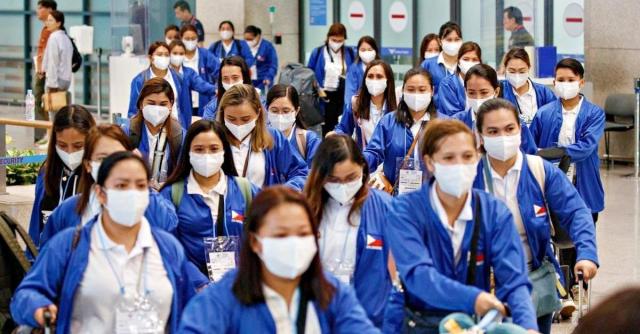
 This undated photo shows Filipino workers arriving at Incheon International Airport to take part in Korea's pilot program for foreign domestic helpers. YonhapSEOUL, January 17 (AJP) - Many Filipino domestic workers in South Korea who came under a government pilot program have suffered from low wages and undervalued care work, according to a new academic study.
 In a paper published Saturday in the journal of the Korean Association for Immigration Policy and Administration, Lee Mi-ae, a professor at Jeju National University’s Research Institute for the Tamla Culture, examined the experiences of Filipino domestic and care workers employed under a pilot project run by the Seoul Metropolitan Government and the Ministry of Employment and Labor. The program brought 100 Filipino housekeepers to Korea to provide child care and household support for dual-income, single-parent and multi‑child families.
Lee and her research team conducted surveys and in-depth interviews between April and May last year with 21 Filipino workers in their 20s and 30s, along with two interpreters.
During the first six months of the program, participants earned an average monthly wage of 1.92 million won ($1,301) before taxes. After deductions for housing, insurance and communication costs, their take-home pay fell to about 1.18 million won, or roughly 51 percent of South Korea’s average monthly wage in 2024, which stood at 3.74 million won.
Their hourly wage was set at 9,860 won, 27 to 35 percent lower than that of domestic childcare providers and household workers, whose pay ranges from 13,590 won to 15,000 won per hour.
Even under a standard 30-hour workweek, monthly deductions of 470,000 to 520,000 won for items such as housing meant that many workers were left with less than 1 million won in net pay.
Several respondents also reported being asked to perform tasks beyond their original scope of work, which was supposed to focus on child care. In addition to looking after children, they said they were expected to clean the house, wash dishes, care for pets and even provide English lessons.
Lee argued that these problems stem from the exclusion of migrant domestic and care workers from the policy‑making process. She said migrant workers’ experiences and voices were largely ignored when South Korea designed its migrant care‑work schemes, with discussions centered instead on users’ needs and employers’ interests.
“Workers’ experiences and voices must be reflected at every stage of policymaking, not only those of service users or employment agencies,” she wrote, calling for stronger labor protections. She also stressed that migrant domestic workers should be allowed to change workplaces without automatically losing their residence status and that their fundamental labor rights be protected.
Lee further urged policymakers to move beyond a narrow focus on low wages and instead re‑evaluate the social value of child care and household labor.
Kim Hee-su Reporter khs@ajupress.com
![[포토] 폭설에 밤 늦게까지 도로 마비](https://image.ajunews.com/content/image/2025/12/05/20251205000920610800.jpg)
![[포토] 알리익스프레스, 광군제 앞두고 팝업스토어 오픈](https://cphoto.asiae.co.kr/listimg_link.php?idx=2&no=2025110714160199219_1762492560.jpg)
![[포토] 국회 예결위 참석하는 김민석 총리](https://cphoto.asiae.co.kr/listimg_link.php?idx=2&no=2025110710410898931_1762479667.jpg)
![[포토] 예지원, 전통과 현대가 공존한 화보 공개](https://image.ajunews.com/content/image/2025/10/09/20251009182431778689.jpg)

![[포토]두산 안재석, 관중석 들썩이게 한 끝내기 2루타](https://file.sportsseoul.com/news/cms/2025/08/28/news-p.v1.20250828.1a1c4d0be7434f6b80434dced03368c0_P1.jpg)

![[작아진 호랑이③] 9위 추락 시 KBO 최초…승리의 여신 떠난 자리, KIA를 덮친 '우승 징크스'](http://www.sportsworldi.com/content/image/2025/09/04/20250904518238.jpg)
![블랙핑크 제니, 매력이 넘쳐! [포토]](https://file.sportsseoul.com/news/cms/2025/09/05/news-p.v1.20250905.c5a971a36b494f9fb24aea8cccf6816f_P1.jpg)
![블랙핑크 제니, 최강매력! [포토]](https://file.sportsseoul.com/news/cms/2025/09/05/news-p.v1.20250905.ed1b2684d2d64e359332640e38dac841_P1.jpg)
![[포토]첫 타석부터 안타 치는 LG 문성주](https://file.sportsseoul.com/news/cms/2025/09/02/news-p.v1.20250902.8962276ed11c468c90062ee85072fa38_P1.jpg)
![[포토] 박지현 '아름다운 미모'](http://www.segye.com/content/image/2025/11/19/20251119519369.jpg)
![[포토] 아홉 '신나는 컴백 무대'](http://www.segye.com/content/image/2025/11/04/20251104514134.jpg)
![[포토] 김고은 '단발 여신'](http://www.segye.com/content/image/2025/09/05/20250905507236.jpg)

![[포토] 박지현 '순백의 여신'](http://www.segye.com/content/image/2025/09/05/20250905507414.jpg)
![[포토] 키스오브라이프 하늘 '완벽한 미모'](http://www.segye.com/content/image/2025/09/05/20250905504457.jpg)
![[포토] '삼양1963 런칭 쇼케이스'](https://image.ajunews.com/content/image/2025/11/03/20251103114008977281.jpg)
![[포토] 언론 현업단체, "시민피해구제 확대 찬성, 권력감시 약화 반대"](https://image.ajunews.com/content/image/2025/09/05/20250905123135571578.jpg)
![[포토] 발표하는 김정수 삼양식품 부회장](https://image.ajunews.com/content/image/2025/11/03/20251103114206916880.jpg)

![[포토] 한샘, '플래그십 부산센텀' 리뉴얼 오픈](https://image.ajunews.com/content/image/2025/10/31/20251031142544910604.jpg)
![[포토] 김고은 '상연 생각에 눈물이 흘러'](http://www.segye.com/content/image/2025/09/05/20250905507613.jpg)
![[포토]끝내기 안타의 기쁨을 만끽하는 두산 안재석](https://file.sportsseoul.com/news/cms/2025/08/28/news-p.v1.20250828.0df70b9fa54d4610990f1b34c08c6a63_P1.jpg)
![[포토] 아이들 소연 '매력적인 눈빛'](http://www.segye.com/content/image/2025/09/12/20250912508492.jpg)
![[포토]두산 안재석, 연장 승부를 끝내는 2루타](https://file.sportsseoul.com/news/cms/2025/08/28/news-p.v1.20250828.b12bc405ed464d9db2c3d324c2491a1d_P1.jpg)
![[포토] 키스오브라이프 쥴리 '단발 여신'](http://www.segye.com/content/image/2025/09/05/20250905504358.jpg)