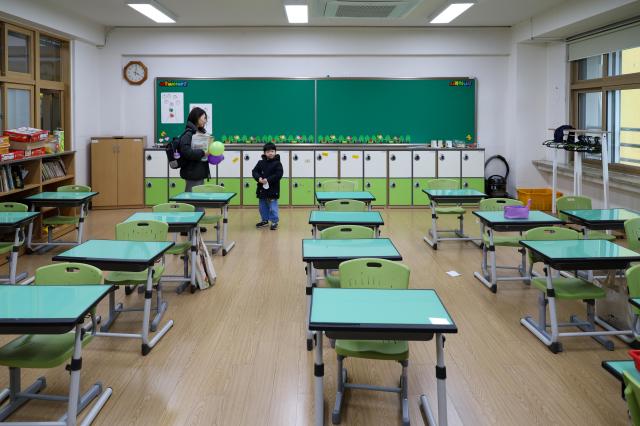
 A first-grader and his mom look around a classroom at an elementary school in Hwagok-dong, western Seoul on Jan. 6, 2026. AJP Yoo Na-hyunSEOUL, January 13 (AJP) - Fewer than 300,000 children will enter first grade across South Korea when the school year begins in March — the smallest cohort on record. The number is set to fall further as the country's ultra-low birthrate continues to hollow out the school-age population.
 These eight-year-olds are starting school at a moment when artificial intelligence (AI) is rapidly reshaping work, production and decision-making across society. Yet serious doubts remain over whether South Korea's education system is prepared to equip them for an AI-driven future — amid a shortage of trained teachers, weak curriculum guidance and limited classroom exposure to AI-related learning.
Dropping below 300,000 first-graders is rare among OECD countries. The demographic shock is already reshaping schools: classes are being merged, and campuses are closing, particularly in rural areas where student numbers have collapsed.
South Korea's total fertility rate rebounded slightly last year to around 0.8 — its first increase in four years — but remains the lowest in the OECD, far below the group's 2023 average of 1.43.
 Graphics by AJP Song Ji-yoonAccording to the Ministry of Education's latest projections for 2026–2031, the number of first-graders nationwide will fall to 298,178. The milestone was originally forecast for 2027, but updated population registry and enrollment data pushed it forward by a year.
 In Seoul, education guidelines flag schools with fewer than three classes per grade or fewer than 18 students per class for potential teacher reductions. Daecheong Elementary School in Ilwon-dong, Gangnam — which has just 75 students in total — proposed a merger with nearby Yeonghee Elementary last November, but shelved the plan after parent opposition. In 2025, Daecheong had a single first-grade class with just eight students.
AI fills labor gaps — but where do children go?
As robots and AI systems increasingly replace younger workers, artificial intelligence is no longer viewed in South Korea merely as a technology, but as a structural response to demographic decline.
Education, however, is lagging far behind that shift.
Efforts to raise AI literacy and close skills gaps remain rudimentary. While AI capabilities are advancing at breakneck speed, school textbooks still reflect the 2022 curriculum revision, instructional hours devoted to information and AI education remain limited, and trained teachers are in short supply.
Under the revised national curriculum in 2022, instructional time for information subjects in primary and secondary schools was roughly doubled. Even so, it remains low by international standards.
In elementary schools, information education totals just 34 hours — 0.58 percent of the 5,892 hours taught over six years — and is embedded within practical arts classes rather than taught as a standalone subject. Middle school students receive 68 hours over three years, about 2 percent of total instruction time. In high school, AI-related courses are electives, meaning many students may graduate without ever taking one.
By comparison, students in the UK receive about 374 hours of information-related instruction, compared with 405 hours in Japan and 212 hours in Beijing. Reflecting this gap, a survey by the Korea Youth Policy Institute found that teenagers rated their experience with AI education at just over 2 out of 4, indicating limited exposure.
"South Korea is trying to build its own AI ecosystem right now, but when it comes to education, I see almost no strategic approach," said An Sun-hoi, a professor at the Graduate School of Education at Joongbu University.
"Education is the area where democracy functions the least," An said. "Policies tend to favor educators as a group, while the demands of industry, parents and national strategy are barely reflected."
As birth cohorts shrink, the stakes are rising, he warned. "We now have to raise a very small pool of human resources into the core talent that will lead the country." He added that greater authority in student evaluation has not translated into clear improvements in learning outcomes.
 A humanoid robot, Atlas, is unveiled at Hyundai Motor Group's press conference ahead of the CES 2026 opening in Las Vegas, Nevada on Jan. 5.Teaching fewer children — more deeply
 Global institutions are calling for a fundamental shift in how societies prepare workers for AI. The World Economic Forum has outlined four possible futures for AI and labor, arguing that a "copilot economy" — where humans and AI work together — is more likely than mass job displacement. McKinsey has likewise emphasized that AI and robotics will increase the value of uniquely human skills such as judgment, communication, coordination and creativity.
Both stress that the future will depend not on a small elite of AI developers, but on a broad workforce capable of understanding and collaborating with AI systems.
"If South Korea continues with its current education system, we risk creating a society where people are subordinated to AI rather than empowered by it," An said. "Critical and creative thinking cannot exist without a solid foundation in knowledge and concepts."
Dr. Nancy Le Nezet, a high school principal at Seoul Foreign School, also emphasized education over restriction.
"Adults need to keep pace with technological developments so they can understand how their children use AI and social media," she said. "Taking an interest in their world is the best way to protect them — and also a way for adults to keep learning."
Experts increasingly argue that instead of shrinking classrooms and cutting staff in line with falling student numbers, South Korea should seize this moment to redesign public education — allocating more teachers, time and resources to each child.
The imbalance is already visible. In Gyeonggi Province, average class sizes in 2025 stood at 21.7 students in elementary schools and 25 in middle schools, both above the national average. Nearly a quarter of classes are overcrowded, forcing schools to rely heavily on temporary teachers. Meanwhile, rural regions are seeing a rapid rise in schools with fewer than 100 students, where staffing shortages make it difficult to offer a full curriculum.
Kim Hee-su Reporter khs@ajupress.com

![[포토] 폭설에 밤 늦게까지 도로 마비](https://image.ajunews.com/content/image/2025/12/05/20251205000920610800.jpg)

![[포토] 국회 예결위 참석하는 김민석 총리](https://cphoto.asiae.co.kr/listimg_link.php?idx=2&no=2025110710410898931_1762479667.jpg)

![[포토] 알리익스프레스, 광군제 앞두고 팝업스토어 오픈](https://cphoto.asiae.co.kr/listimg_link.php?idx=2&no=2025110714160199219_1762492560.jpg)
![[포토] 예지원, 전통과 현대가 공존한 화보 공개](https://image.ajunews.com/content/image/2025/10/09/20251009182431778689.jpg)

![[포토]두산 안재석, 관중석 들썩이게 한 끝내기 2루타](https://file.sportsseoul.com/news/cms/2025/08/28/news-p.v1.20250828.1a1c4d0be7434f6b80434dced03368c0_P1.jpg)
![[작아진 호랑이③] 9위 추락 시 KBO 최초…승리의 여신 떠난 자리, KIA를 덮친 '우승 징크스'](http://www.sportsworldi.com/content/image/2025/09/04/20250904518238.jpg)
![블랙핑크 제니, 최강매력! [포토]](https://file.sportsseoul.com/news/cms/2025/09/05/news-p.v1.20250905.ed1b2684d2d64e359332640e38dac841_P1.jpg)
![[포토]첫 타석부터 안타 치는 LG 문성주](https://file.sportsseoul.com/news/cms/2025/09/02/news-p.v1.20250902.8962276ed11c468c90062ee85072fa38_P1.jpg)
![[포토] 아홉 '신나는 컴백 무대'](http://www.segye.com/content/image/2025/11/04/20251104514134.jpg)
![블랙핑크 제니, 매력이 넘쳐! [포토]](https://file.sportsseoul.com/news/cms/2025/09/05/news-p.v1.20250905.c5a971a36b494f9fb24aea8cccf6816f_P1.jpg)
![[포토] 키스오브라이프 하늘 '완벽한 미모'](http://www.segye.com/content/image/2025/09/05/20250905504457.jpg)
![[포토] 박지현 '아름다운 미모'](http://www.segye.com/content/image/2025/11/19/20251119519369.jpg)

![[포토] 박지현 '순백의 여신'](http://www.segye.com/content/image/2025/09/05/20250905507414.jpg)
![[포토] 김고은 '단발 여신'](http://www.segye.com/content/image/2025/09/05/20250905507236.jpg)
![[포토] 발표하는 김정수 삼양식품 부회장](https://image.ajunews.com/content/image/2025/11/03/20251103114206916880.jpg)
![[포토] 언론 현업단체, "시민피해구제 확대 찬성, 권력감시 약화 반대"](https://image.ajunews.com/content/image/2025/09/05/20250905123135571578.jpg)
![[포토] '삼양1963 런칭 쇼케이스'](https://image.ajunews.com/content/image/2025/11/03/20251103114008977281.jpg)
![[포토] 김고은 '상연 생각에 눈물이 흘러'](http://www.segye.com/content/image/2025/09/05/20250905507613.jpg)
![[포토] 아이들 소연 '매력적인 눈빛'](http://www.segye.com/content/image/2025/09/12/20250912508492.jpg)
![[포토]끝내기 안타의 기쁨을 만끽하는 두산 안재석](https://file.sportsseoul.com/news/cms/2025/08/28/news-p.v1.20250828.0df70b9fa54d4610990f1b34c08c6a63_P1.jpg)
![[포토] 한샘, '플래그십 부산센텀' 리뉴얼 오픈](https://image.ajunews.com/content/image/2025/10/31/20251031142544910604.jpg)

![[포토]두산 안재석, 연장 승부를 끝내는 2루타](https://file.sportsseoul.com/news/cms/2025/08/28/news-p.v1.20250828.b12bc405ed464d9db2c3d324c2491a1d_P1.jpg)
![[포토] 키스오브라이프 쥴리 '단발 여신'](http://www.segye.com/content/image/2025/09/05/20250905504358.jpg)